
How to grow spirulina in 7 easy steps
We've got your back every step of the way
STEP 1
Get a pure live culture of Limnospira platensis
It all starts with a live Spirulina culture. It’s like you need a seed or a cutting to grow a tree. In this case, you need a quantity of liquid Spirulina culture to start your journey.
The spirulina cells, which form themselves into spiral arrangements (or trichomes, as they are called) are suspended in a growth medium which provides them with a source of carbon dioxide and nutrients. You only need a relatively small amount of culture to get started. Under the right conditions, the cells rapidly divide, so you can expand the volume of your culture at a geometric rate.
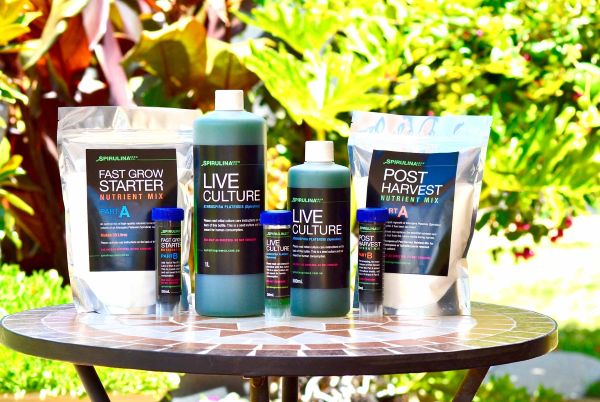
When buying a culture, there are a few things to be aware of:
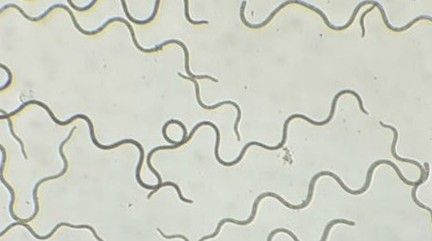
Get the right strain
It is important to get the right sort of spiurlina. There are different species and strains. You want the curly variety, Limnospira platensis, because it is much easier to harvest.
make sure you start with a pure culture that is not contaminated with other organisms.
If your culture is contaminated with other organisms, particularly chlorella, you will never get rid of them and your culture will not do well because you have another organism competing for recourses. Try to get you culture examined under a microscope. The science department of your local school will have microscopes - it should look similar to the photo above. If there are other green looking organisms or anything else that looks like another organism - check again once the pH is up to 10 and if it is still there throw out the culture and start again.
Get a Reasonable Amount to start with.
You could start with just a few ml of culture and, if you care for it, you could grow enough to fill a swimming pool.
However, small amounts are vulnerable. It is better to start with around 500 ml. The more, the better.
Buy local
Whilst you can buy live spirulina cultures from reputable sources overseas, you run the risk of it dying in transit or being confiscated by customs. Remember, it’s illegal to import live organisms without a material transfer agreement, import licenses, and customs clearances. It’s safer to buy a live culture from your home country.
Spirulina Grow Co is based in Australia and only services the Australian domestic market with live cultures.
Information and Support
Growing Spirulina is easy, but like anything, there are a few tricks. Make sure get reliable information on what to do when you receive your culture if you are getting started for the first time.
When you buy from us, we offer detailed instructions and excellent after-sales. We are generous with information and want you to succeed.
STEP 2
transfer culture to a transparent container
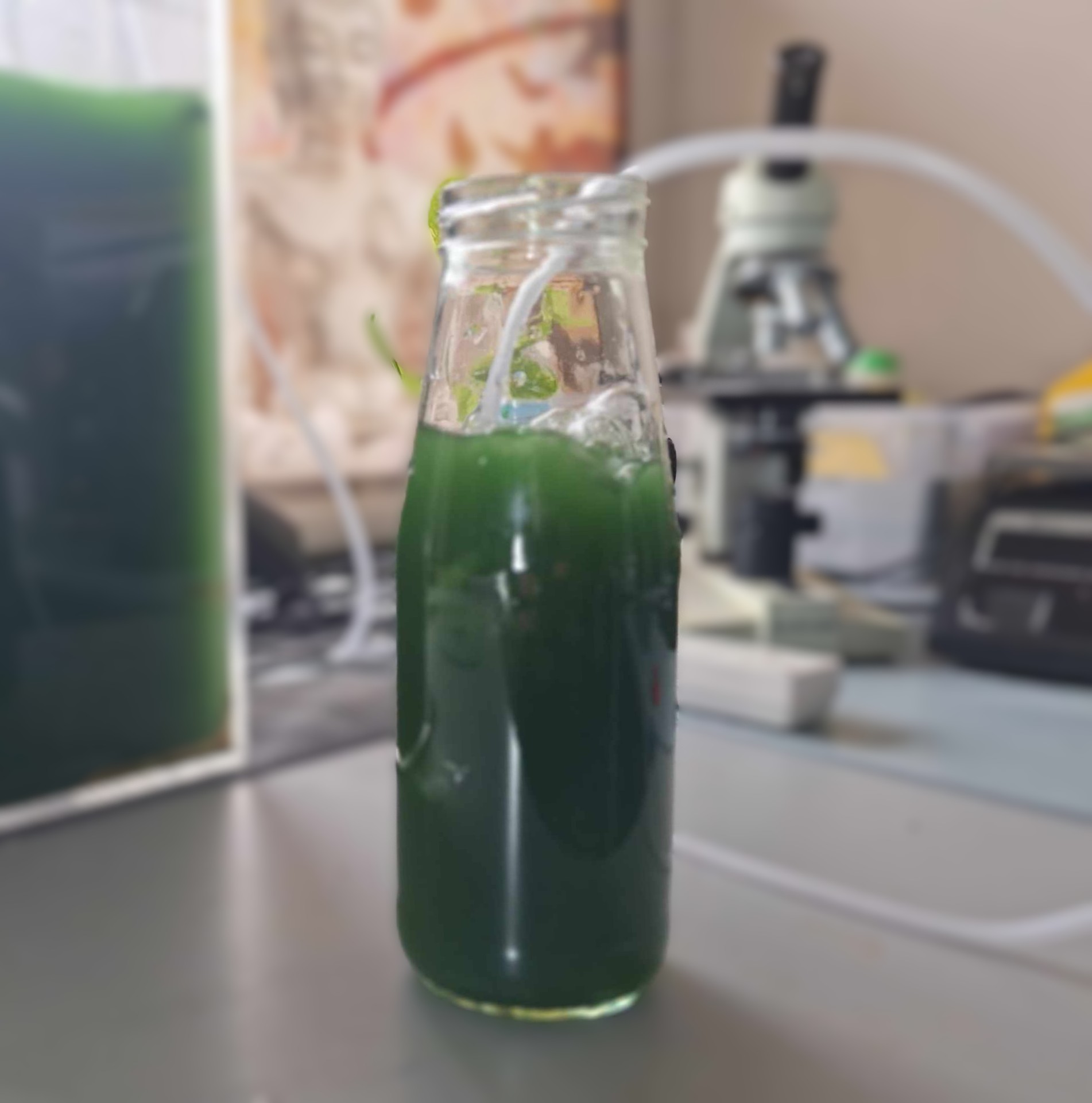
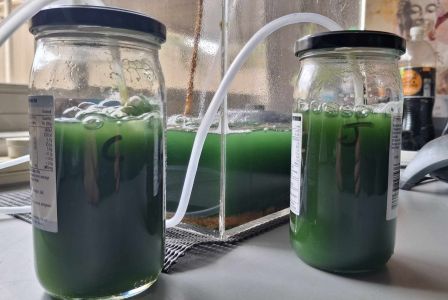
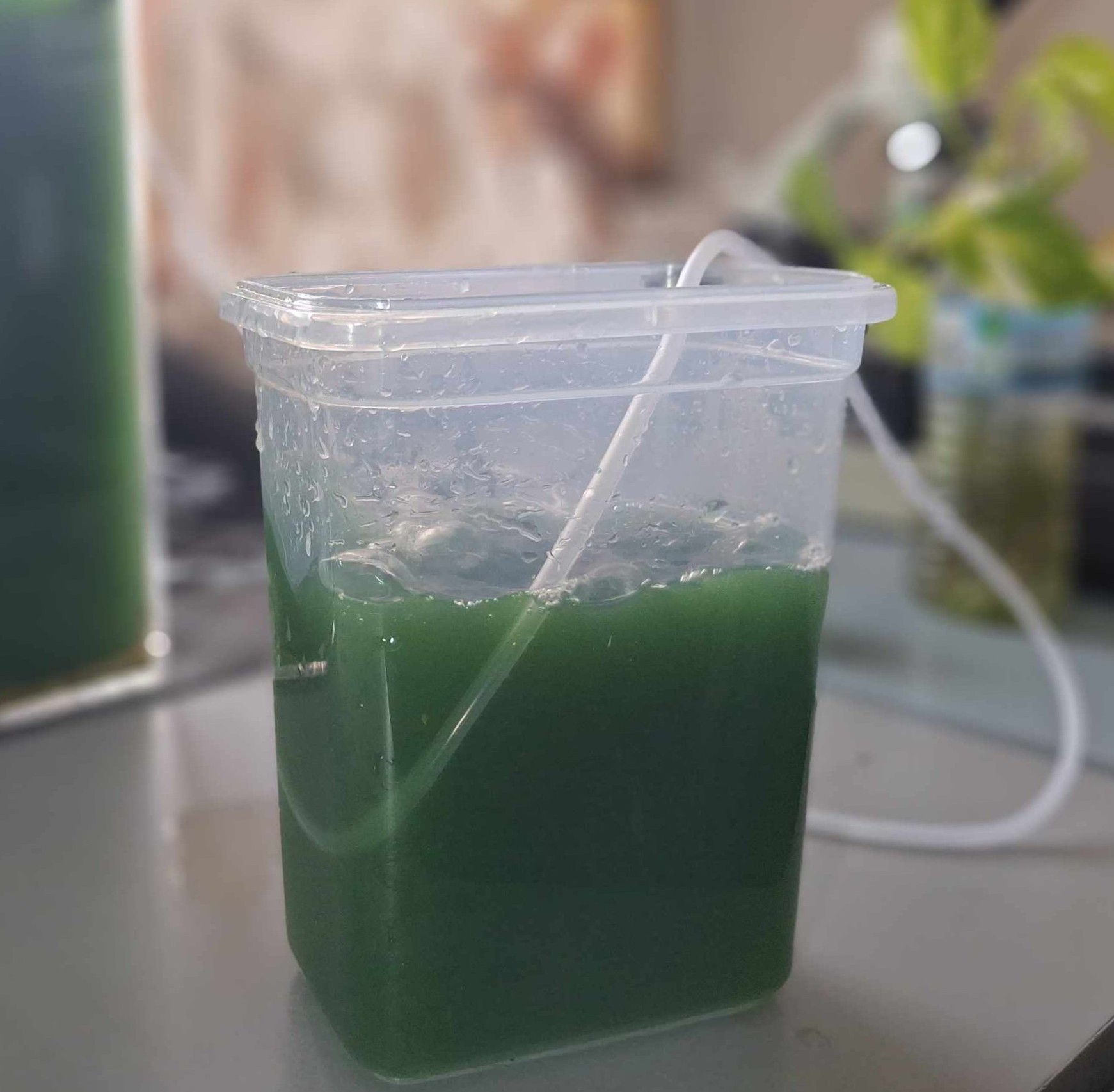
Any clean, non-reactive, transparent container will do. You could use a storage container, a glass bottle, a plastic drink bottle or a glass jar. The container used should be 2 -3 times the volume of the culture your received, to allow for build up but not so large that the culture is just covering the bottom of the container. Ideally, for small volumes, the container should be taller rather than wide and squat, which allows for better agitation and light penetration.
STEP 3
add sunlight
Remember, Spirulina, like grass and trees, is a photosynthetic organism. It uses the sun’s energy to turn carbon dioxide into sugar. In this sense, light is like Spirulina’s food. This means the quality of light reaching your culture is of vital importance and will determine how well it grows. When your Spirulina culture is thriving and strong, the general rule is that more light is better. Thus, the more surface area of the culture exposed to the light, the faster it will grow. Sunlight is best because it carries a lot more energy than even the strongest light globe and is composed of the correct light frequencies for Spirulina.

However, with sunlight, there are two caveats to the more-light-the-better rule:
- Sunlight carries a lot of energy and will heat your culture tank (bioreactor) up quite quickly, particularly if the ambient temperature is hot. That is why it is important to monitor the temperature of your culture. You may need to shade the bioreactor to reduce the heat load during the hottest times of the day.
- When the culture is young and not very dense, too much sunshine can hurt them. They get sunburnt. Therefore, when you are growing your culture up after first receiving it you will need to shade it. You can do this by placing some see-through fabric over the bioreactor
As your culture grows and becomes more dense, it will shade itself. When assessing if you should shade your culture the general rule is: if you can see all the way through the culture, or most of the way in, then you should shade it.

Artificial light
As you consider artificial light, remember that it’s pretty hard to compete with natural light, which can be 100 times brighter than artificial light. Further, the sunlight has a full spectrum of wavelengths that Spirulina can use to photosynthesize. However, if you are growing Spirulina inside, and you are not getting good natural light, or if you want to boost the growth rate of your culture, then artificial lights are a good strategy.
A general rule of thumb for Spirulina is to choose a light that has warmer colours that contain light in the orange to red range (625 – 650 nm). These wavelengths allow Spirulina to absorb a higher fraction of the light and increase the growth rate.
For an average-sized aquarium, you could use a 600ml 2 tube fitting with 6,500K 24″ T8 17W Bulbs. Put the lights on a timer and set it on a 16 – 8 hours day-night cycle. Spirulina needs a day and night cycle to thrive. You could also use LED light banks sold for hydroponics setups. An example of which, is shown to the side.
STEP 4
add bubbles
Remember, when the culture is dense, light can only penetrate a short distance into it. That means that only the spirulina trichomes on the outside and top of you bioreactor are illuminated. It is important that each Spirulina filament regularly get some sunlight. However, it is also important that they are not overexposed. So, the trick is to give the filaments enough light to facilitate photosynthesis but not too much so that they are damaged (sunburnt) or their photosynthetic system is overloaded. That’s why is it crucial to keep the culture moving during sunlight hours. This will force Spirulina filaments to the surface, or near the transparent walls, for a short while.
mixing is achieved by bubbling air through the culture.
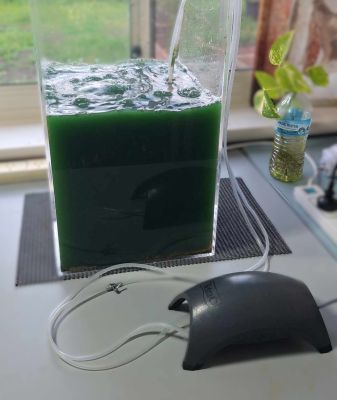
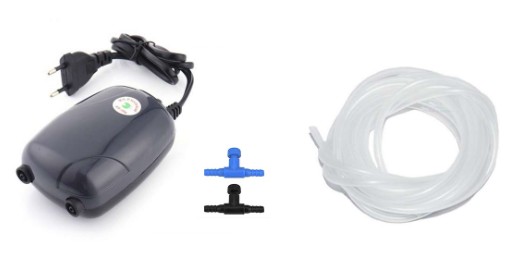
Mixing, as suggested here, is achieved by bubbling air through the bioreactor. The bubbles also facilitated gas exchange with the air. To do this all you need is an aquarium air pump and some tubing.
a note of caution
Make sure that the bubbles are not too aggressive otherwise they will break up the Spirulina strands causing losses as cells are ruptured. If this is the case, you will find the surface of the bioreactor covered in foam caused by the contents of the ruptured cells.
You can regulate the intensity of the bubbles by installing a in-line screw value in the tubing
STEP 5
build up to final volume
The idea here is to grow your culture slowly whilst maintaining a deep green colour as you go.
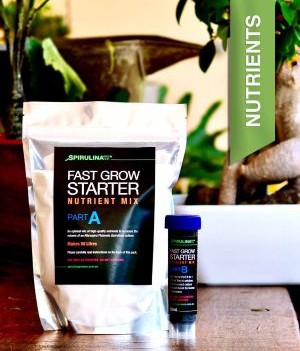
If your conditions are favorable, then you can increase the volume of your culture by adding a starter nutrient media at a rate of about one-third of the volume of the culture every 2-3 days.
Your culture is ready to increase when you notice a light border at the edges of your bioreactor of around 2cm. That means the culture is quite dense and light can only penetrate 2cm in.
Theoretically, you can grow 1000 s of liters of culture from just 10 ml of original culture. The trick is to build up slowly and pay attention and maintain optimal growing conditions.
The nutrient medium
You increase the volume with a starter nutrient media that is composed of a source of CO2, usually sodium bicarbonate, plus a suite of nutrients that spirulina needs to grow and multiply. The nutrients are more or less composed of the same elements that that you would feed a plant. They include:
- A source of fixed nitrogen – that is, nitrogen bonded with other elements, such as oxygen to make nitrate (NO3-1) or urea, which is nitrogen bonded with oxygen, carbon, and hydrogen (NH2CONH2). In these formats, the nitrogen is soluble in water and thus available for uptake by the reproducing Spirulina
- A source of key nutrients: iron, phosphorus, potassium, sulfur, calcium, chlorine, and magnesium
- A source of trace elements – these are essential nutrients needed only in extremely small quantities such as boron, cobalt, manganese, zinc, and copper
Final Volume
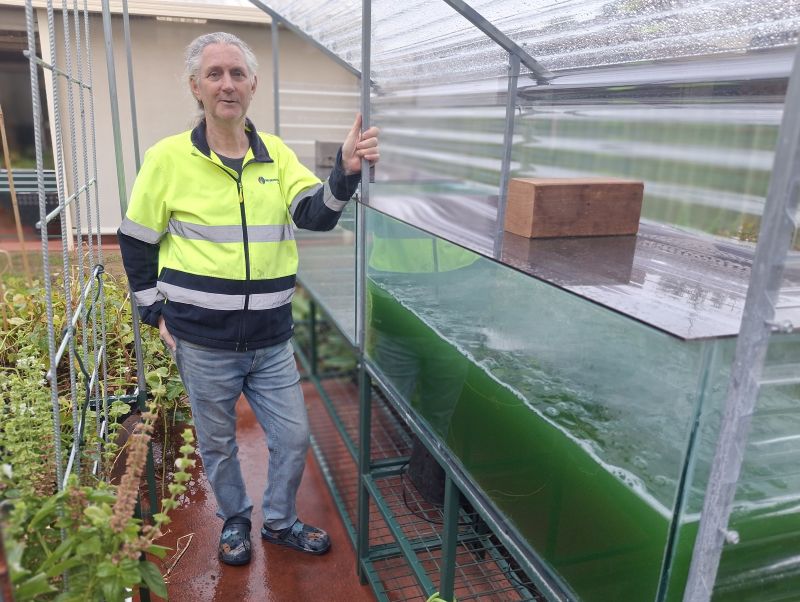
Your aim is to build your culture to a final working volume that will yield the amount to spirulina you desire. To give you an idea a 120 L bioreactor will easily and safely yield 1kg of fresh spirulina a week with 2 harvests. This is not putting a lot of pressure on the culture.
Aquariums make excellent bioreactors and can be picked up quite cheap second hand.
If you were starting with 1L and you have favorable conditions, warm and good light, you should be able to reach a volume of 120L in about 35 days if you increase every 3 days.
STEP 6
harvest
When to harvest
Your culture is ready to harvest when it’s dark green or the sun penetrates the culture to 2cm or less and the pH is over 10. Remember, it’s important to wait for the pH to get up to 10 to reduce the risk of contamination with potentially harmful organisms.If your conditions are ideal and growth is good you can expect to harvest every 3-4 days.
Remember, under ideal conditions a Spirulina culture can double its weight every 3 –4 days. Be aware that you can leave your culture unharvested for longer periods but you will suffer a significant drop in production due to the increased density, which causes a reduction in light penetration into the culture.
You will also find that as the culture gets super dense it will tend to clump together and float on the surface. If this is left too long then it will go brown and icky.

how to harvest
Harvesting is easy. All you do is filter the culture through a fine silkscreen fabric as demonstrated by Josh in the video above. The most efficient way to harvest Spirulina is by using a mesh frame that fits your bioreactor. A mesh frame is made by stretching and fixing the filter fabric (mesh) onto a frame so it is taut. If you are a bit handy, you can easily make one using wood, screws, staples, glue and varnish. Or get a handyman to make one for you. It’s well worth the effort or expense. You can also buy ready-made silkscreens from a silkscreen supplier as per the picture to the left.
How much to harvest
The general principle here is that you don’t want to harvest so much that the culture becomes too sparse and open open to sun damage. As you harvest and return the filtrate (the solution left after filtering out the Spirulina) back to the culture, if you can see more than 4cm under the surface, then it’s time to stop. As a general rule, plan on harvesting about on third to half of your total volume each harvest.
what to do with your harvest
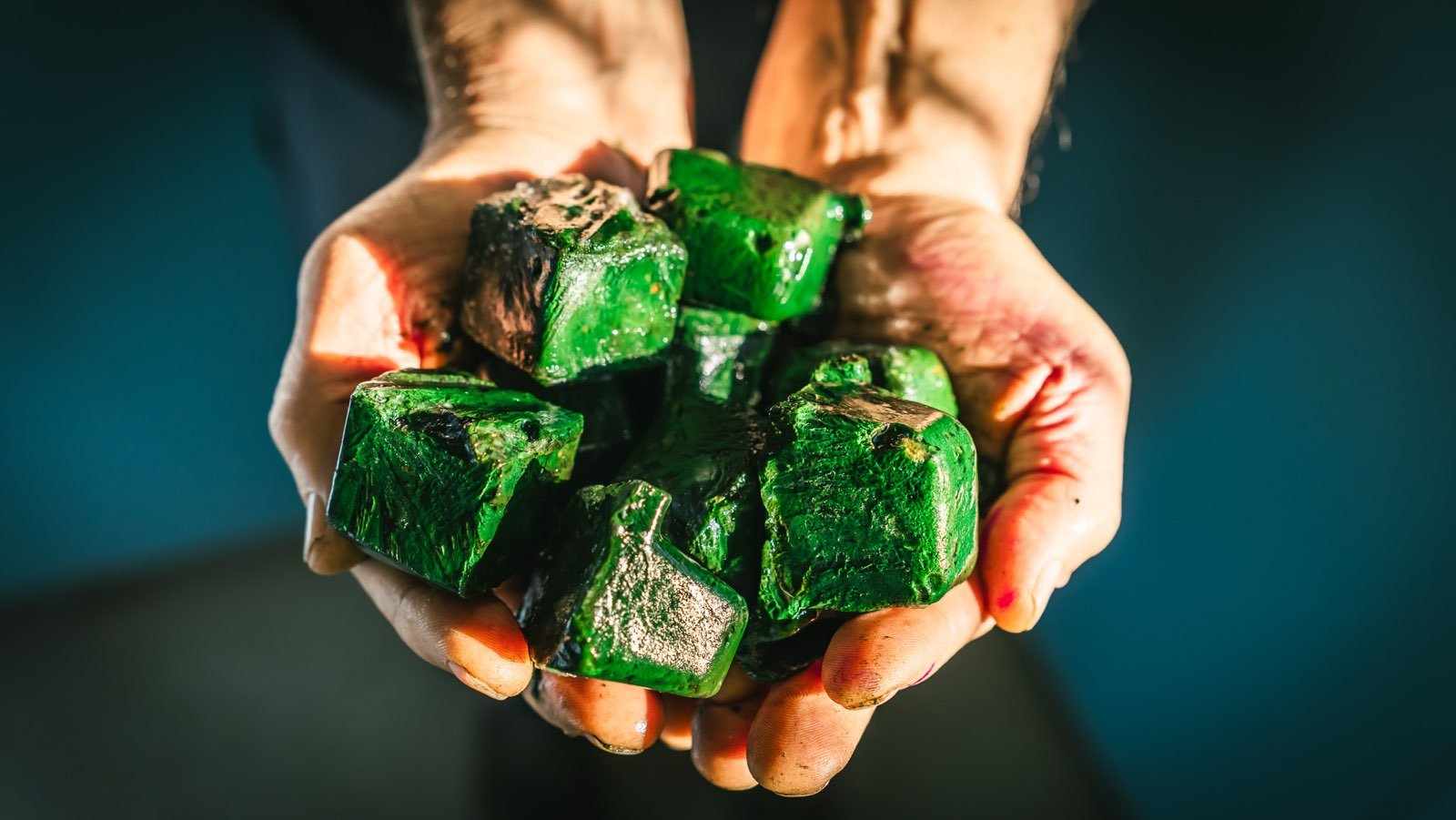
The best thing to do with your harvest is to use what you need immediately and then freeze the rest. Because it is such a dense source of protein and nutrients it is very attractive to other microorganism and it will go off quite quickly.
You can also spread it thinly on backing paper and dry it.
STEP 7
feed
When you harvest Spirulina, you remove nutrients from the system because they become locked up in the Spirulina biomass. This means to grow more Spirulina, you need to add more nutrients.
The nutrient mix you use for post-harvest feeding is different than the formula used to build up the volume of your culture.
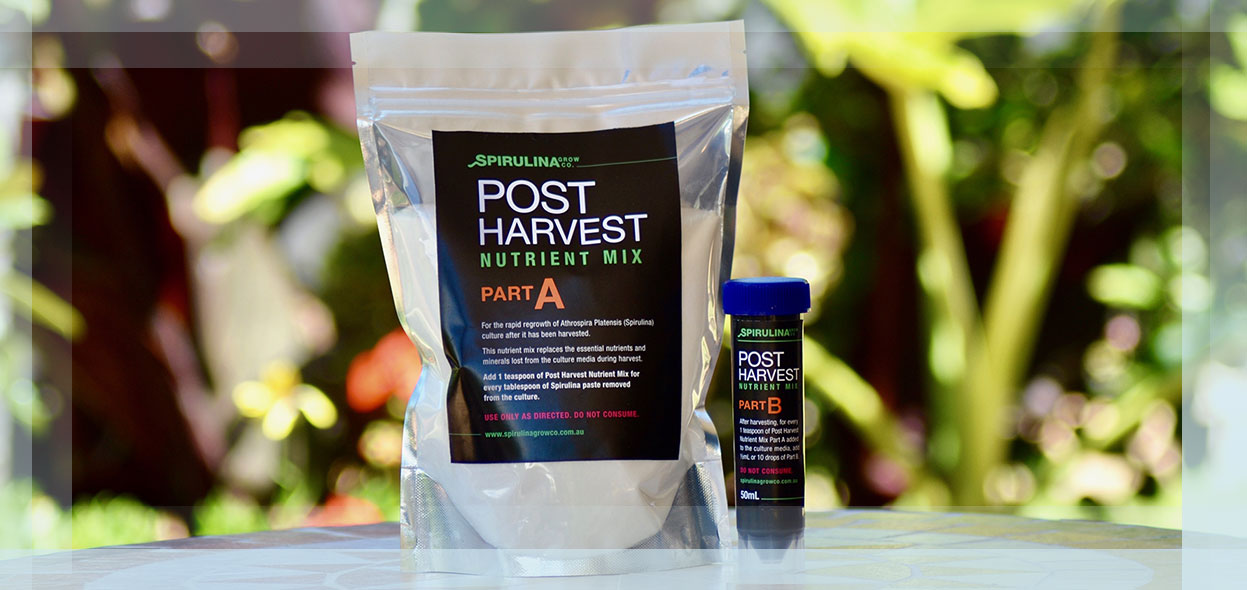
There are various formulas you can find online to make up your post-harvest mix. Most ingredients are easy to find in the marketplace but the problem is that often buying in relatively small amounts is super expensive. You can buy the post-harvest mix from our shop if you don’t want the up front expense of buying in bulk or messing around with formulation.
For the post-harvest nutrient mix that we sell, you add 1 teaspoon of nutrients to the culture for every tablespoon of thick Spirulina paste that you harvest.
In summary
Growing and harvesting spirulina is easy. If you follow these simple steps and pay attention to maintaining good conditions your spirulina will keep rewarding you with the most powerful superfood on the planet.
Remember, if you buy from us, you are supplied with a comprehensive step-by-step grow guide and email support.
Everything you need to start growing your own fresh spirulina
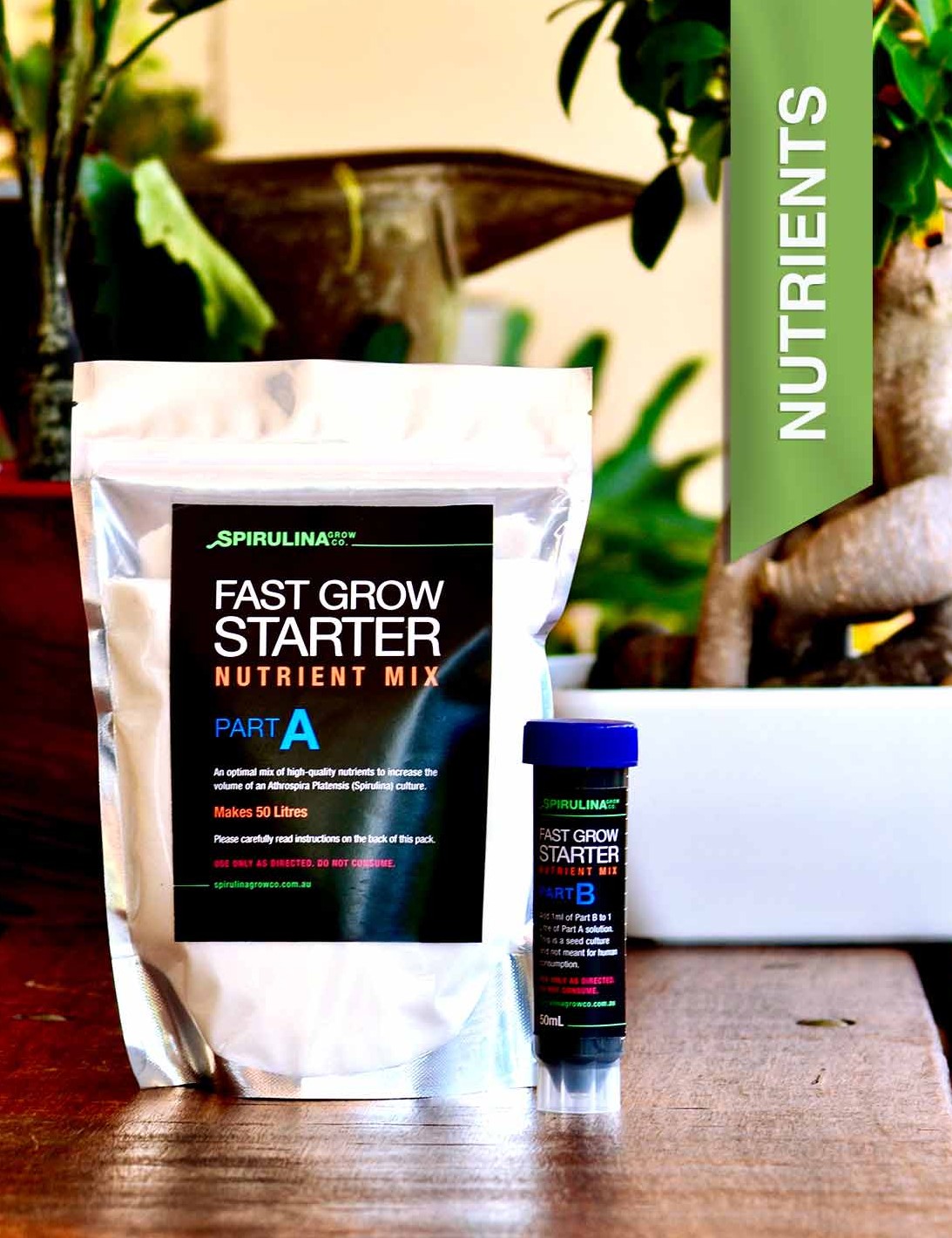
Fast Grow Starter Nutrient Pack For Cultivating your Spirulina
The starter nutrient pack is specially formulated for the rapid and healthy growth of your Spirulina culture. These nutrients are free from contaminants and heavy metals.
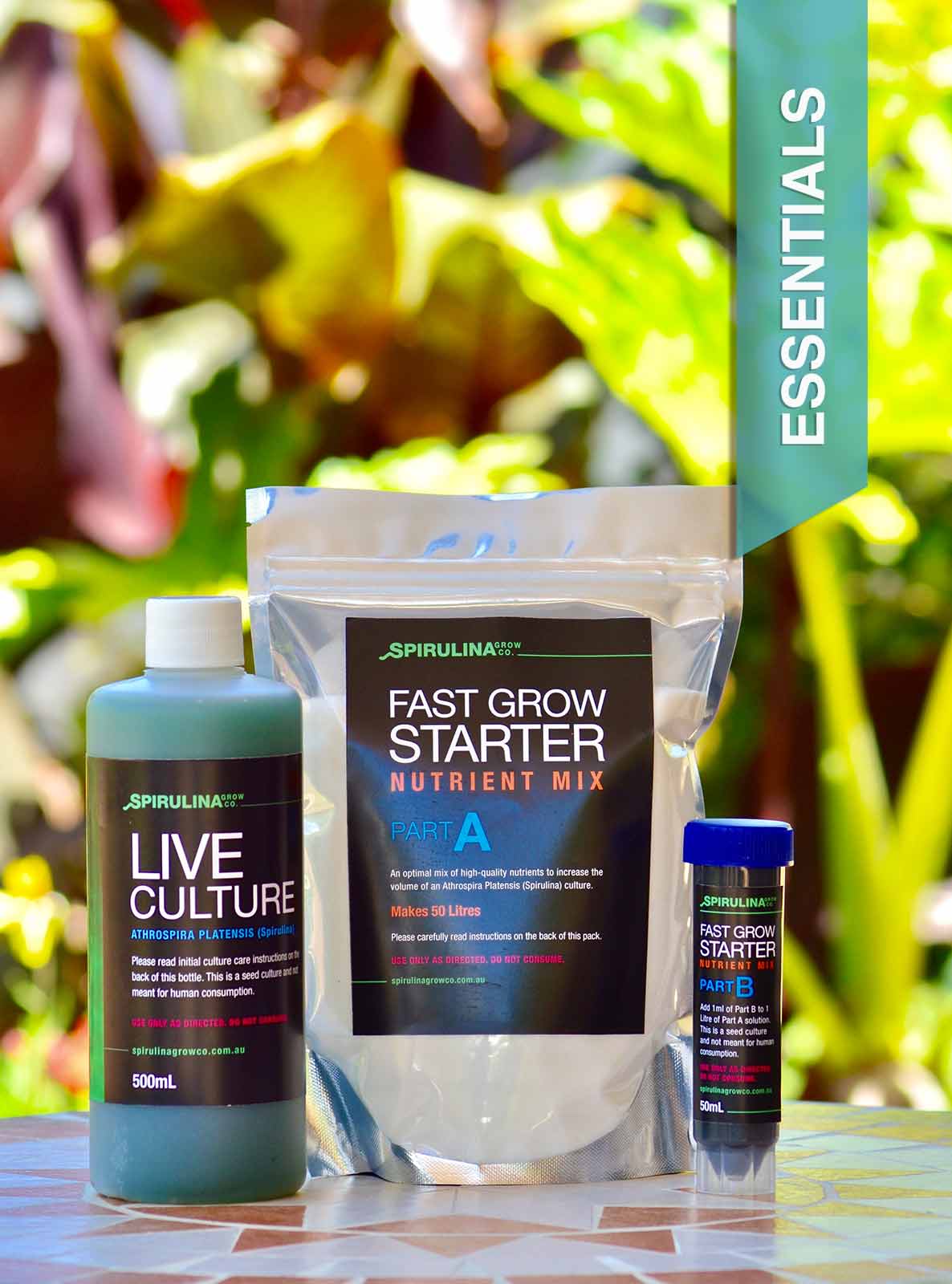
500 ml live Spirulina culture and Fast Grow starter nutrient pack
The 500 ml live culture and starter nutrient pack along with the comprehensive instruction manual contain the essential components needed to get your spirulina micro-farm established.
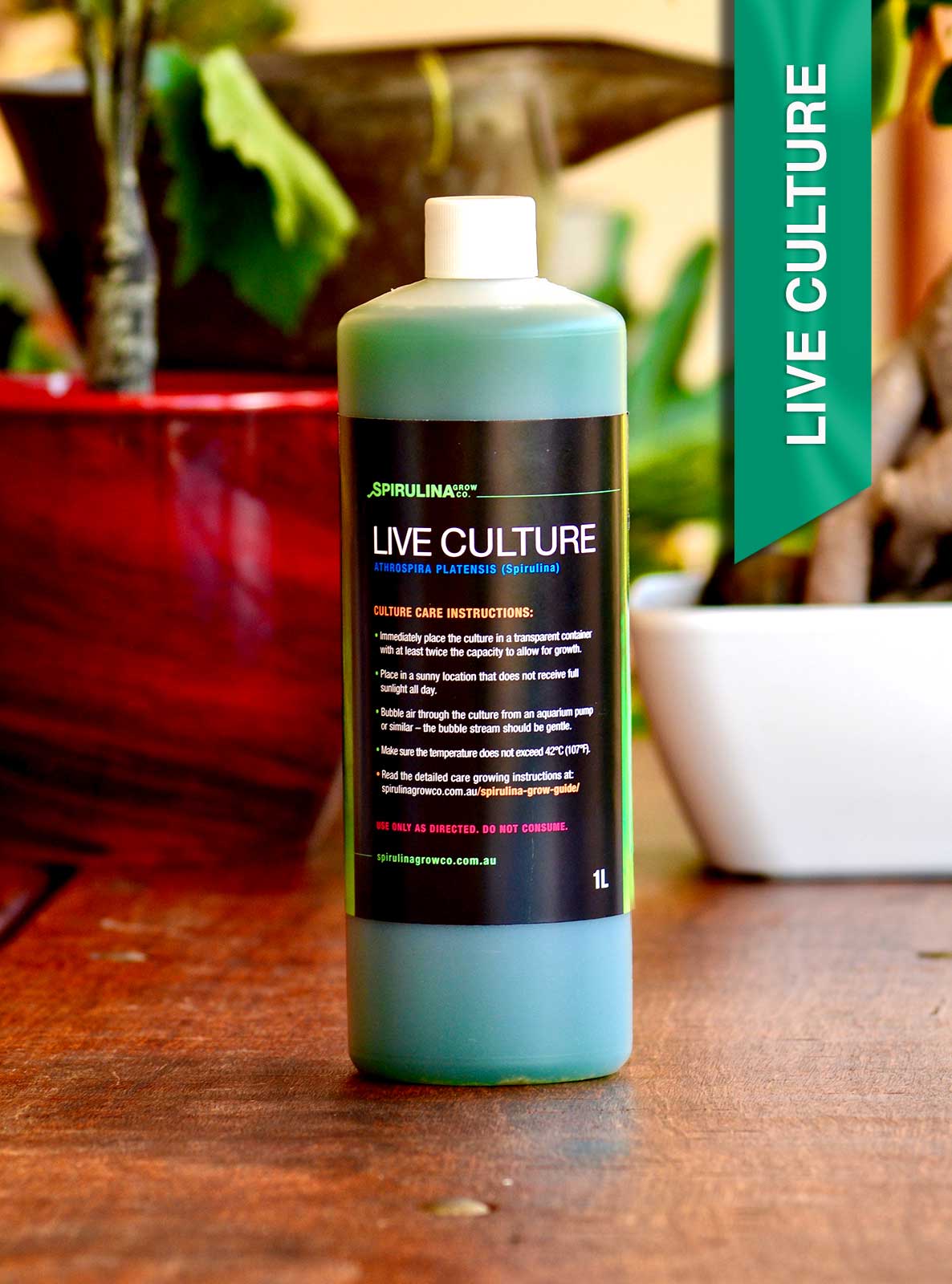
1000 ml of live seed culture - checked for purity
If you feel comfortable formulating and sourcing your own starter nutrient mix then the 1-liter live starter culture is all you need from us to get your Spirulina micro-farm established.
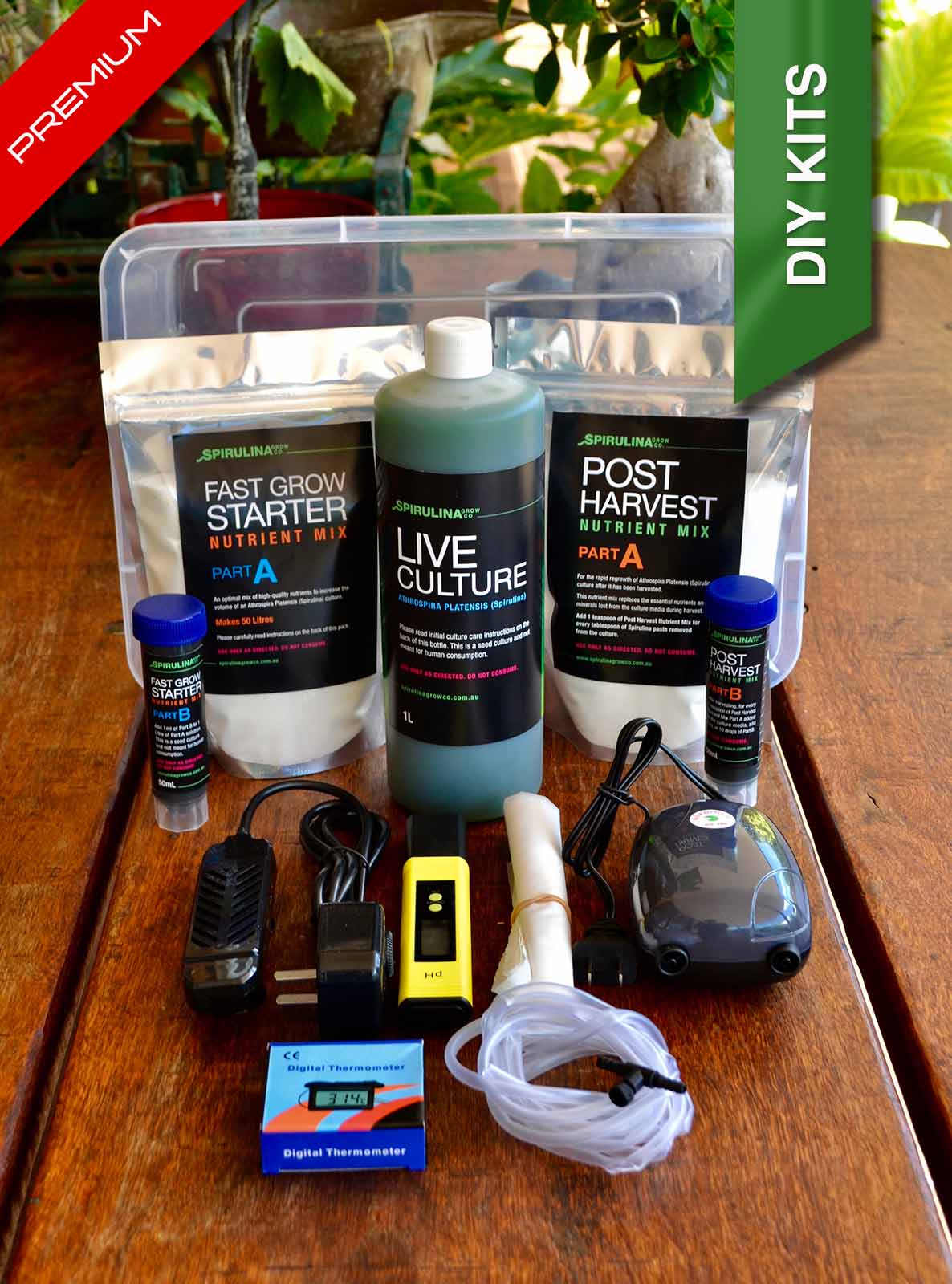
Premium Spirulina Farming Kit – Everything you need to start!
This Premium Spirulina kit that contains all the essential information, equipment, nutrients and culture needed to start, monitor, maintain and harvest your own Spirulina at home
Copyright 2026 , all rights reserved.